Doner kebab | The king of street foods across the globe
If you have ever been to Turkey and have Turkish friends, you probably know that each one will do their best to convince you that a dessert or some other dish is the best from their area. When it comes to the doner kebab, it’s not much different. Chances are, you were convinced that quite a few eateries were the only places that served the authentic doner kebab. If you decide to delve deeper into the story of this phenomenally popular kebab of international fame, again, you find out things are not that simple.
Origin of the doner kebab
When discussing the origin of the doner kebab, there are two key aspects: one is the technique of stacking meat cuts to rotate and slowly cook, and the other is the horizontal spit becoming vertical.
According to Priscilla Mary Işın, the author of Ottoman Kebab Culture and the Rise of Doner Kebab, a French traveler, Bertrandon de la Broquière, passed through Anatolia in 1433. He describes a meal that sheds light on the evolution of the doner kebab. He was invited to join a group of Turkish travelers for a meal on the wayside. He explains that a spit-roast sheep was being prepared, and while the meat roasted, they cut off slices to eat the cooked surface. This was a method to save time, particularly while traveling. It is easy to imagine that eventually the meat was cut into slices with fatty and lean parts evenly distributed on the spit.
This was the time when meat roasted on a spit, such as shish kebab, was prepared mainly for royalty and the upper classes. The generic Turkish term for various kinds of meat roasted in this manner was çevirme kebap or turned kebab, appearing in early 15th century texts. In the 20th century, the term was transcribed in English as shawarma or the revolving kebab.
Then the author mentions that in 1666, the Ottoman traveler Evlija Çelebi records in his travelogue that he was invited to a feast by Crimean Tartars, where the main dish was doner kebab on a horizontal spit. Sheep meat was cut into slices and threaded on an iron kebab spit.
However, fifty years earlier than Evlija’s description, two instances of doner kebab roasting on a horizontal spit occur in Turkish literature. In a Turkish translation of the epic Persian poem Shahnama, there are miniature-style illustrations. One scene shows the roasting of meat after an animal is hunted. However, in the Turkish translation, instead of the whole animal, we see the doner kebab. Another miniature shows the Persian poet Firdausi, author of Shahnama, having a picnic with three other poets. In the background, a cook is cutting a slice off the doner kebab.
The patron of the manuscript, Hafiz Ahmad Pasha, was an important figure at the Ottoman court, familiar with the court cuisine at the time. We can safely assume that the doner was a picnic food for the sultans of the period.
The Crimean region was an Ottoman protectorate from 1475 to 1774, so it’s not surprising that the doner kebab was found in Istanbul as well as the lands of the Crimean Tatars. Evliya describes in his accounts that the dish was prepared throughout Crimea at public events on winter nights. The fire was traditionally fueled by a cartwheel. The Tatars told him the story of the origin of this custom. A nomadic Tatar slaughtered a fat sheep to serve to his Nogai (also a Turkic ethnic group) guest. No firewood was to be found in the steppe. The Tatar took the wheel of his cart and used it as firewood. The Nogai was so grateful that he later sent him seven carts full of goods.
From court delicacy to street food
From accounts of foreign travelers to Istanbul during the 1800s, we know that during the 18th century, the dish was being prepared and sold in kebab houses all over Istanbul. The royal picnic food was now a popular street food. It is also around this time that the horizontal spit became the vertical rotisserie. This was probably done to save space in the small kebab houses.
The dish quickly became popular throughout various provinces and was available in every cook-shop in Turkish towns. While there was a tradition of royal cooks strictly guarding the secrets of dishes served to the elite, during the 18th century, this was already beginning to fade away. The doner, once reserved for the tables of sultans and royal picnics, had truly evolved into readily available, cheap, fast food, prepared on a vertical spit.
The evolution of doner kebab: Doner goes global
Ottoman chefs mastered the art of roasting meat on a vertical spit during the 18th and 19th centuries. Marinated cuts of lamb or beef were stacked on the skewer and cooked, slowly rotating over an open flame. The outer layers became crispy, and the meat retained its juices, creating a unique texture and flavor. Serving the meat in thinly carved slices was another innovation that made it very attractive, as it could easily be wrapped up in bread.
The cooking technique spread quickly across the Levant region, reaching other lands and taking on local twists and names.
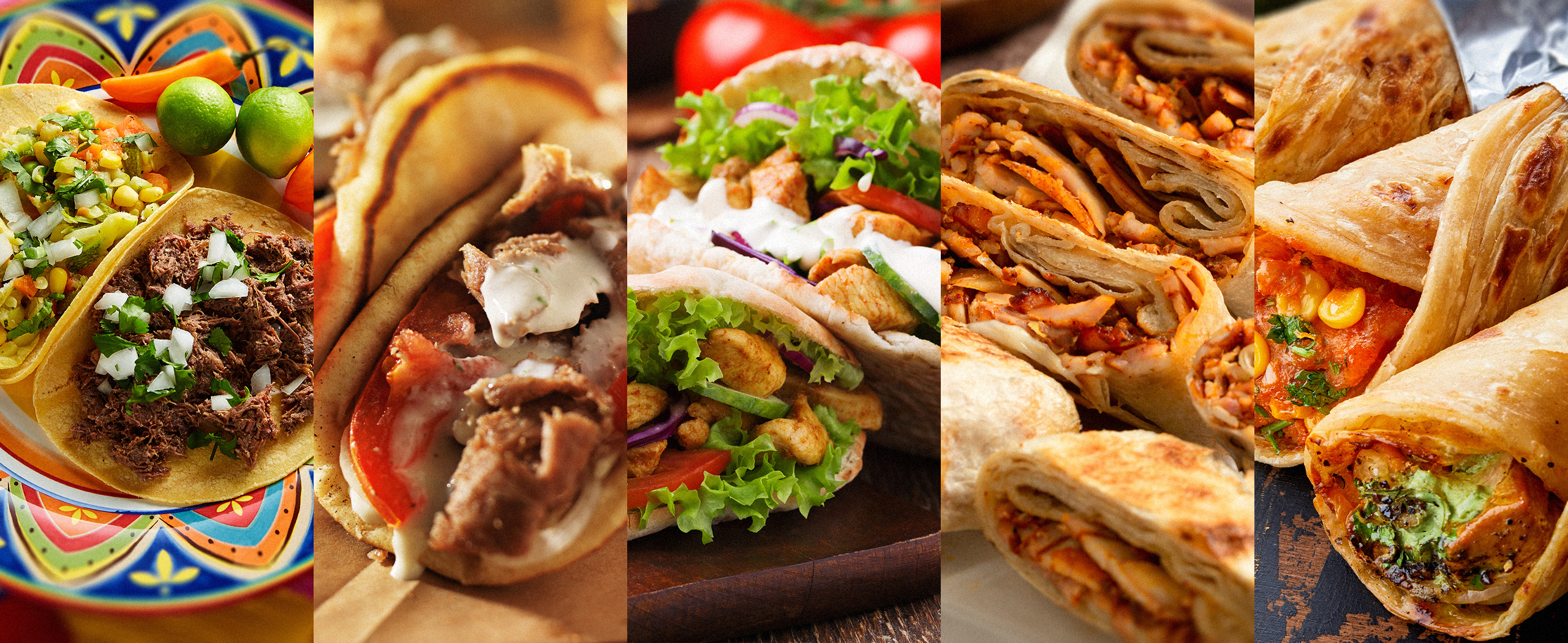
Traditionally, it is prepared from lamb shoulder, but today beef and chicken are also popular doner kebab variations. The meat is spiced with cumin, coriander, turmeric, and paprika. Typically, it is served with tahini sauce, hummus, pickles, tomatoes, lettuce, cucumber seasoned with sumac, and yogurt, etc. It can be eaten with rice and bread, and also packed as a wrap or a sandwich.
Moving towards the Mediterranean, the dish merged with local trends and is often called shawarma. In Jordan, Lebanon, Syria, etc., shawarma is frequently wrapped in thin pita bread and then grilled.
The Greeks adopted the meat-roasting method that Turkish immigrants brought with them, but the Greek version is called gyros, served with tzatziki sauce.
Generally speaking, the flavors from the Levant and Greece are more citrusy, fresh, and light.
In the West, the doner is widely available both as street food and in restaurants. Beef and chicken are the most commonly used meats. Vegetarian versions with plant-based meat are also available. In North America, it is often served with sauces such as garlic mayo or hot sauce.
Many street vendors or restaurants serve doner made with unwholesome meat and without the traditional fresh and healthy side-dishes, leaving consumers, particularly those in the West, under the impression that it is a fatty and unhealthy dish, suitable only for late night snack after partying. But whoever tries high-quality doner kebab, made with quality ingredients according to traditional standards, realizes that it is far from a greasy indulgence. It can be a healthy and balanced meal together with grilled vegetables and salads, or a quick and affordable wrap packed with healthy vitamins, proteins, and carbs.
Iskender Efendi and Kadir Nurman
As we have seen, the history of the doner kebab is a long one, and it would be difficult to tie a particular name to the invention of the methodology of preparing this kebab. However, some names stand out in relation to the doner.
Many who visit Turkey, particularly the historical city of Bursa, become convinced that Iskedner Efendi was the man who practically invented the doner. However, Iskender Efendi was a young and creative cook, and his special way of preparing and serving the kebab became an institution in itself, called the Iskender kebab or Bursa kebab. He was inspired by the doner but didn’t create it. His particular version is made with tender lamb, beef, or chicken slices cooked on a vertical rotisserie. The meat is served on top of a base created with pita bread pieces. It is covered in generous quantities of tomato sauce and melted sheep butter. The dish comes with a side of creamy yogurt.
Another name closely associated with doner kebab is that of Kadir Nurman. After his demise in Germany in 2013, he was hailed as the ‘Inventor of the doner kebab’.
Nurman arrived in Germany during the 1960s and 70s with other guest workers from Turkey and stayed. He opened up a food stall. He sold doner kebab sandwiches. However, the title bestowed on Nurman is misleading. He played a significant role in the popularization of the doner, but the kebab had been served as a sandwich in the Middle East long before Nurman started his food business.
Concluding words…
Doner kebab is definitely one of those dishes that have become so massively popular around the globe that, regardless of the country, people have embraced it as part of their own food culture.
The dish that started as a picnic food of choice for Ottoman royalty has become available to people around the world from different cultural backgrounds. It has evolved to adapt to different culinary traditions. The doner kebab has also merged with Michelin-starred cooking. Michelin-starred chef Brad Carter has created his uniquely styled doner in Manchester, presenting an accessible Michelin-star-meets-comfort-food concept. The doner kebab can be an ancient royal and luxurious delicacy, an affordable and convenient sandwich, and a modern Michelin star innovation.