Rolling through time with spring rolls—from Asia to the Americas
Spring rolls emerged from ancient Chinese customs that welcomed spring. Its Mandarin name, chūnjuǎn, combines two words—chūn meaning ‘the spring season’, and juǎn meaning ‘to roll’. The Chinese enjoy this snack year-round, but it has a special place in their New Year celebrations, also known as the Spring Festival.
Over the centuries, the spring roll has inspired many variations, fried and cold, with vegetable and/or meat, chicken, and seafood fillings, made with rice-flour or wheat-flour wraps, and served with a variety of sauces. One reason for its global adoption and immense popularity is the universal appeal of wrapped and rolled foods that has not faded since ancient times.
The origin and history of spring rolls
The origin of spring rolls is not well documented. Presumably, the concept existed in China before the Tang Dynasty (618-907). At that time, the spring roll was more like a pancake that loosely wrapped special vegetables and fruits to celebrate the coming of spring.
A collection of stories, The Shoufu (Garden of Urban Stories), compiled in China during the 1368-1370 period, mentions spring rolls as an ancient food with roots in the Jin dynasty (317-420), when specific fresh vegetables were eaten as the ‘pungent platter’ to celebrate the new year. Five pungent vegetables—garlic, shallots, leeks, field mustard, and cilantro (some say garlic, chives, leek, cabbage, and coriander) were rolled into steamed pancakes made from flour and water. People believed the dish was good for the health of five internal organs (liver, lungs, heart, spleen, kidneys) and to meet the challenges of the new year.
During the Tang (618-907) and Song (960-1279) dynasties, the pancakes evolved, and so did the fillings. The ancient ‘spring dish’ became a favorite of the rich, who added unique ingredients to the fillings—it was no longer about carrots and celery, but boasted new flavors.
Instead of flour and water, they made pancakes from wheat flour and eggs, and fillings from fresh spring produce and additional items such as lettuce, bamboo shoots, and radishes. Ingredients were served individually on ‘a spring platter’. The poet Du Fu mentions this dish in his poem Lichun (“Beginning of Spring”)—a nostalgic lament—reminiscing about the delights of the capital city while in exile after a rebellion. Later, they broadened the spring platter by adding other vegetables and also meats. Spring rolls for the rich were filled with meat, eggs, spinach, and bean sprouts, while the poor still resorted to affordable ingredients like carrots and celery.
The ‘spring dish’ continued to evolve through subsequent dynasties, with each era adding something different—making it more luxurious and befitting the elite palate. The Yuan dynasty (1279-1368) chefs began frying the pancake wrapper filled with spring vegetables instead of steaming or cooking it on a griddle. During the Ming Dynasty (1369-1644), spring pancakes began to resemble the rolls we know today, but it was the Qing Dynasty (1644-1912) chefs who folded the ‘pancake’ into a compact roll with premium fillings.
Today’s fried spring roll thus appeared—now called chūnjuǎn.
Common folks and elites loved it alike. It even featured as a pastry at the Manchu Han Imperial Feast, the legendary Chinese banquet. It became the signature food of the Spring Festival. But its future was bigger than just being a seasonal Chinese delicacy. Popular worldwide, it has become a symbol of cultural identity. You can find it in Chinese, Vietnamese, and other Asian cuisines, as well as in European and American cuisines—in exciting, novel, and tasty varieties.
Spring rolls—the mark of a successful new year
The spring roll changed over time, but it was always linked to the coming of a new year, a new beginning, the start of a new cycle of life, a new spring.
The Chinese New Year (even when the lunisolar calendar date falls on a winter day) marks the Spring Festival, and has been celebrated for nearly 3,500 years. From ancient rituals of worship and offerings to gods to modern-day entertainment shows, social gatherings and celebrations, the activities to mark the day have kept changing.
The ‘spring dish’ also evolved from humble beginnings into the crispy, golden fried ‘spring roll’ that cannot be missing from traditional Spring Festival celebrations. The cylindrical shape and golden color of spring rolls make them resemble gold bars—worthy of an auspicious meal that marks a new beginning with hope for wealth and prosperity.
Spring rolls vs. summer rolls—What is the difference?
The confusion between spring and summer rolls is common. However, summer rolls are Vietnamese. Unlike the Chinese spring rolls, they are never cooked and are light, cooling, and refreshing. They are served cold or at room temperature. They use rice paper to wrap fillings made of rice vermicelli, fresh veggies, raw shrimp, or pork. They’re traditionally served with hoisin or peanut dipping sauce. Vietnamese summer rolls are also called ‘salad rolls’, rice paper rolls, or fresh spring rolls’, and are known as Gỏi cuốn.
Fried spring rolls may use rice flour for the wrapper, but are typically made with wheat flour. The pastry dough is stuffed with meat and vegetables and always cooked—traditionally deep-fried until golden and crispy. They are crunchy with a moist, spicy, and savory filling and strong flavors. Fresh spring or summer rolls are slightly chewy, with a crunch that comes from the fresh ingredients inside. Their overall flavor is lighter and fresher, and they contain fewer calories and less fat than fried spring rolls.
We see many regional variations of summer and spring rolls across the Far East. Some have a dual character too—they are served uncooked like Vietnamese summer rolls and deep-fried like the Chinese spring rolls. For instance, the Popiah can be deep-fried or eaten cold depending on the region—its thin paper-like crepe is made from wheat flour and rolls an assortment of fresh, dried, or cooked ingredients. It is served with a sweet sauce. The Lumpia is another example of a summer cum spring roll. The paper-thin wrapper rolls sweet and savory fillings and is deep-fried or served fresh with a peanut-based sauce.
Fresh spring and summer rolls—from Vietnam to China
While the typical Chinese spring roll is a fried golden delight with a wide variety of delicious fillings and sauces, soft fresh spring or summer rolls are also part of Chinese culinary traditions—served at room temperature.
In Quanzhou, Fujian province, fresh spring rolls are stuffed with seafood and vegetables, and dipped in a sweet and sour sauce sprinkled with seaweed.
In Guiyang, the capital of Guizhou province, food stalls sell a dish called Si Wawa. It is a soft spring roll filled with finely shredded cucumber, radish, bean sprouts, and local herbs, rolled into a rice flour pancake. The wrapper is also made from a mix of rice and wheat flour. This fresh spring roll is covered with a spicy, sour sauce made with tomatoes, chilis, and vinegar.
Moving south toward Vietnam, in Beihai, Vietnamese spring rolls are filled with fresh shrimp, cucumber, and pork. The wrapper is a rice flour pancake. They are served with a sweet and spicy dipping sauce made with lemon, fish sauce, and chilis. Of course, when in Vietnam, you are in the home of the fresh spring roll, or the summer roll, Gỏi cuốn.
The Vietnamese also have their own fried spring roll, Chả giò. It has a thicker wrapper made from wheat flour, water, salt, and egg. The filling is richer, too, with ground pork, chicken, shrimp, or beef, sautéed before wrapping and frying.
Fried spring rolls VS American egg rolls
Presumably, egg rolls you’re served in Chinese-American restaurants are an innovation by the chefs who adapted the Chinese snack for the American palate. Traditional Chinese spring roll wrappers are lighter, while American egg roll wrappers use a rich pastry dough made with lots of eggs. The dough is prepared such that when fried, the rolls puff up. The outer layer becomes crunchy, then a bit chewy, before you reach the filling—altogether, they are thicker and resemble other batter-fried foods common in the US. Traditional Chinese fried spring rolls are super crunchy because the wrapper is pastry dough made with only wheat flour, water, and salt—no eggs.
The fillings are also quite different. Spring rolls usually contain more vegetables and less seafood, meat, and chicken. American egg rolls are usually filled with bacon and cabbage, pork, chicken, or avocado.
Fried spring rolls: Popular cultural varieties
The Chinese Chūnjuǎn
A thin wheat flour wrapper rolls vegetables such as cabbage, carrots, and onions. Meat-based chūnjuǎn is usually filled with pork, chicken, or seafood. You can enjoy the chūnjuǎn with many sauces—sweet and sour, soy with chili, and chili garlic are the most popular.
The Japanese Harumaki
Harumaki is the Japanese version of spring rolls filled with local ingredients such as shiitake mushrooms, shrimp, chicken, glass noodles, bamboo shoots, and carrots. Deep-fried until golden brown, Harumaki is served with soy sauce, rice vinegar, or karashi mustard.
The Vietnamese Chả giò
Chả giò or Nem rán is a Vietnamese spring roll also known as the Vietnamese egg roll. It uses a rice paper wrapper that becomes crispy when fried, and is filled with seasoned ground meat, vermicelli, and veggies. The Vietnamese serve these spring rolls wrapped in lettuce with a fish-based sauce or raw vegetables.
The Thai Poh-pia-tod
Poh-pia-tod is the Thai version of fried spring rolls. They are filled with ground pork, shrimp, cabbage, carrots, bean sprouts, and glass noodles. The ingredients are sautéed in light oil, rolled into the wrapper, and deep-fried. Pop-pia-tod is usually served with a sweet chili sauce.
The Filipino Lumpia Shanghai
The Filipino version of the Chinese fried spring roll is filled with ground pork, carrots, and onions, rolled in a thin flour-based wrapper. These tight cigar-shaped spring rolls are deep-fried and served with banana ketchup or sweet chili sauce.
The Cambodian Naem Chien
The Cambodian version of the spring roll is lighter than its Chinese counterpart because it uses uncooked ingredients for the filling. It also uses fish sauce instead of the common soy sauce or oyster sauce, adding depth to the flavor.
The Indonesian Risoles
This Indonesian take on spring rolls typically features a creamy filling of minced meat or fish rolled in a thin, crepe-like wrapper coated with breadcrumbs for texture. The creamy inside contrasts with the crunchy outside, making it everyone’s favorite. Risoles are best served with a spicy dip or mustard.
South Asian spring rolls
In South Asian countries like India and Pakistan, spring rolls are a popular snack food. The wrapper, known as ‘roll-patti’, is made of wheat flour rolled out into thin sheets. The rolls are usually filled with cabbage, chicken, carrots, and eggs, mixed with spices.
Panthera, or pan roll, is the Anglo-Indian version of the spring roll. The super-crispy wrapper rolls seasoned ground or minced meat, onion, ginger, and garlic. Its vegetarian version is usually filled with paneer and veggies, and the wrapper is made from flour, eggs, and water or milk. This Indian fried spring roll is also coated in breadcrumbs for extra crunch.
The American Egg Rolls
The quintessential American-Chinese food is a wrapper made of wheat flour and eggs—hence its name, some believe. NYC claims to be its birthplace. The traditional thick egg roll was different—made with bamboo shoots, pork, shrimp mince, scallions, etc. But its takeout version is a tad simpler—filled with bacon and cabbage, pork, chicken, or avocado. Egg rolls are served with a sweet and sour sauce, soy sauce, duck sauce, or hot mustard.
The Aussie Chiko Roll
This funny-sounding name is the Australian version of the fried spring roll, created by Frank McEnroe in 1951. It was created as a thicker spring roll to hold up during football games, where it is a stadium favorite. The wrapper is a thick pastry tube made with egg and flour, and has a crunchy exterior and a doughy interior. The filling is an interesting mix of cabbage, barley, carrots, green beans, celery, onion, wheat cereal, and beef. Chiko roll also has a vegetarian version.
European spring rolls
Across Europe, we find an exciting variety of spring rolls with unique names and shapes. Their fillings also vary depending on seasonal and local ingredients. You’ll find them in Western and Central Europe, and across Scandinavia. The British take on spring rolls is the popular pancake roll with meaty and veggie fillings.
Spring rolls in Latin America
In Latin America, spring rolls have a story similar to Europe. You see them in Brazil, Chile, Costa Rica, Mexico, Argentina, Uruguay, and Venezuela. They come with different names and have adapted to local tastes. Their wrappers and fillings also vary by region. The most popular spring roll across the region is Rollo Primavera—filled with veggies, often with minced meat. It is enjoyed fresh and fried. The wrapper is made from wheat flour for the fried variety and rice flour for the fresh.
Frozen spring rolls—all the ways you can cook them
Not everyone likes deep-frying because of health concerns, personal taste, or because we don’t want a huge oily mess in our kitchen, but we may still want to eat dishes that are typically prepared by deep-frying. Fortunately, we now have options like the air-fryer and conventional oven, so we can avoid deep-frying the spring rolls.
To air-fry frozen spring rolls, preheat the fryer to 400F. For safety purposes, don’t place foil in the fryer while it’s preheating. Place the spring rolls in a single layer with some space between them, and air-fry for 9 to 10 minutes.
You can also bake frozen spring rolls to a crisp golden brown in a conventional oven. Preheat the oven to 425F. Line a baking sheet with aluminium foil, place the spring rolls on it with space between them, and bake for 12-15 minutes.
If you don’t mind the extra kitchen mess or the calories, deep-frying is the best option—so go ahead and prepare them the authentic way.
Try Kaiser’s variety of frozen spring rolls.
|
Typical sauces and dips to serve with spring rolls
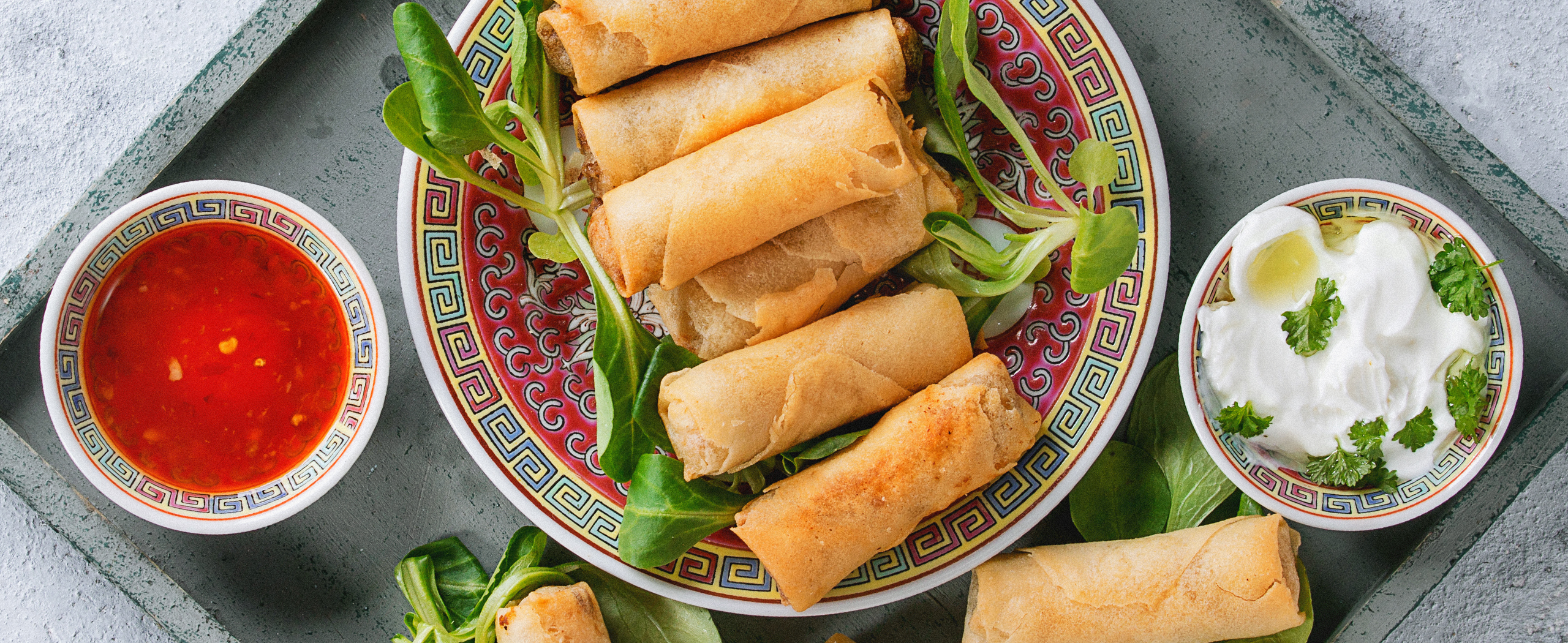
When it comes to dipping sauces for fried spring rolls, you should follow your heart. If you want ketchup, mayo, a mix of both, a bit of mustard or honey mustard, or a thick cheesy sauce with Jalapeno peppers, who is to say no!
Innovating, mixing and matching different textures and flavors is how we truly enjoy our food—so go ahead and dip your spring roll in the sauce you love. After all, the fried spring roll kept changing over time, and even today someone somewhere may be putting a new twist on the snack.
But if you want something more traditional, try Jamie’s recipes for three sauces that are typically served with spring rolls:
- The peanut dipping sauce—creamy, sweet, and nutty
- The Vietnamese fish sauce, or nuoc cham—spicy and citrusy
- The hoisin sauce with soybean—lots of umami.
You can add fresh greens of your choice—such as lettuce.
For all practical purposes, spring rolls are so versatile, you can serve them with any dipping sauce or salad you prefer, and even build a meal by adding them to a Vietnamese-style bowl with noodles and salad, or fried rice.
Rolling this up…
The story of the spring roll reflects the beauty of food culture—how a humble snack that marked the advent of spring in ancient China evolved into a globally popular food item; how different people and cultures helped shape its numerous regional varieties; and how, like kebab and samosa, the spring roll has connected people across centuries and continents.
Today, fried spring rolls with unique fillings are far beyond the Far East. One of the most popular snacks worldwide and a beloved appetizer, they’re enjoyed in their traditional form and in varieties that cultural fusion has brought to life. Wrapper types, fillings, cooking methods, and sauces vary with local culinary traditions, but people’s love for spring rolls doesn’t. `
Commonly asked questions about spring rolls
What is a spring roll wrapper made of?
Spring roll wrappers are typically made of wheat or rice flour, water, and salt, but sometimes both wheat and rice flour are used.
What is the typical spring roll filling?
The typical fillings for the Chinese spring roll, chūnjuǎn, include vegetables such as cabbage, carrots, and onions. Meat-based fillings are usually based on pork, chicken, or seafood.
What is the difference between spring and summer rolls?
Summer rolls are Vietnamese. They are never cooked and are served cold or at room temperature, unlike Chinese spring rolls that are traditionally deep-fried. Summer roll wrappers are made from rice paper, whereas spring roll wrappers are typically made from wheat flour. Summer rolls wrap ingredients like rice vermicelli, fresh veggies, raw shrimp, or pork. Spring rolls use veggies, pork, chicken, or seafood. Summer rolls have a light, cooling, and refreshing flavor, whereas spring rolls are strong, spicy, and savory. Summer rolls are slightly chewy, with a crunch that comes from the fresh ingredients inside. Spring rolls are crunchy on the outside and moist and juicy inside.
Which are the best sauces to serve with spring rolls?
The best sauces for spring and summer rolls are traditional choices like peanut dipping sauce, Vietnamese fish sauce, and hoisin sauce with soybean.
What makes fried spring rolls crispy?
The wrapper you use, the moisture content in the filling, and how you fry the spring roll determine how crispy it turns out.
Can I air fry spring rolls?
Yes. Air frying is a great choice if you want to cut calories and fat content in fried spring rolls.
Are spring rolls healthy?
If you’re looking for healthy spring rolls, you’ll have to opt for fresh or summer rolls that are not deep-fried.


